Skip navigation
Skip navigation

1

Early engagement with First Nations

2

First Nations rights in land and sea

3

Safeguarding cultural heritage

4

Negotiating access to land and sea country

5

Investing in First Nations Businesses and Suppliers

6

First Nations Land and Water Management

1.

Early engagement with First Nations

Early engagement enabling Free, Prior and Informed Consent (FPIC) is central to proposed clean energy projects in Australia.

Early engagement proactively exercises First Nations rights and responsibilities and protects community interests. It can mean the difference between project sustainability and unnecessary risk, cost and delay.

First Nations expect early engagement prior to a project being developed. In many cases there may also be a legal requirement to engage.

Engage early. Partner right. Build better.

Early engagement leading to Free Prior and Informed Consent (FPIC) is getting to know and understand First Nations people likely to be impacted by a proposed clean energy project at a time and place of their choosing, from conception through to site selection, and ongoing throughout the project’s life-cycle. Developers and investors must aim to ensure future owners also adhere to this principle.

Proponents must seek to understand the culture, history, challenges and aspirations of the First Nations groups that the proponent is going to working with. This will assist in co-designing strategies and projects – such as equity shares or community benefit funds – that will come out of the project and lead to greater impact as it will respond to what the community wants and needs. 

Early engagement is all parties understanding where each other are coming from, setting expectations, looking for ways the community can capitalise on the opportunities, agreeing on communication protocols, and setting out steps for a successful relationship and project. Transparent information must be shared in a manner accessible to all parties including information about the companies involved, the proposed project, the risk to Country and families, and other relevant materials.

Many First Nations groups have pre-designed their own protocols for engagement with clear expectations built in. For example:

Gunaikurnai Land and Waters Aboriginal Corporation (GLaWAC) have produced a guide to assist developers to negotiate major projects with GLaWAC, with an expectation that all industries and governments involved in major project development on their country will be forming agreements with GLaWAC in line with international best practice.

Nari Nari Tribal Council are only looking to work with proponents that are prepared to: 

  • properly value Nari Nari’s contribution of knowledge and skills; 
  • work hard to meet Nari Nari’s decision making responsibilities; 
  • share knowledge and skills and pay for Nari Nari’s independent advice; 
  • agree to Nari Nari’s FPIC; and 
  • agree that Nari Nari should share in wealth creation, above and beyond landholdings, as an equity share.
The Yindjibarndi people believe in the principles set out in the United Nations Declaration of the Rights of Indigenous Peoples (UNDRIP), including the right to own, control and develop their Ngurra (country).

Balanggarra’s vision includes:

  • Balanggarra Traditional Owners will give permission for and decide on access to our country
  • we will manage our own country by our own rules and others engage properly with Balanggarra Traditional Owners
  • we want to keep our culture, language and law alive, protected and recognised
  • we want to give our young people education, training, and employment for business opportunities on country to protect and control country.

Putting in place mechanisms to build respectful relationships must be prioritised from the very start of scoping a project and patiently developed as projects progress. 

That includes enacting the principle of ‘proponent pays’ – proponents should put money on the table up front if they want engagement, including for Prescribed Body Corporate (PBC) fees and regulations.

A strong relationship helps with planning, design and construction, and it also plays a big role in the long-term success and sustainability of the project.

Establishing equitable relationships with impacted and neighbouring First Nations communities is also a good idea for building trust, and employment and procurement opportunities.

Responsibility of industry and investors: Start with consent

Clean energy projects should proceed only with the Free, Prior and Informed Consent (FPIC) of relevant Traditional Owners. Where native title is relevant FPIC requires an Indigenous Land Use Agreement (ILUA). 

Notwithstanding Australia’s legal and regulatory framework for negotiating access to First Nations country, projects will only succeed if they engage with FPIC and go beyond their legal obligations.

Project proponents must guarantee and ensure First Nations communities are genuinely informed and real consent is obtained throughout all stages of the project.

The first step is identifying the First Nations group to engage, who has cultural authority, as well as which individuals to speak to. 

The next key challenge is turning FPIC as a theory into practice. A good starting point is understanding what FPIC means for Traditional Owners relevant to a project or area. That includes the broader aspirations of the Traditional Owner group(s) impacted.

FPIC is more than securing an agreement with Traditional Owners at the start of a project. It’s about developing an ongoing process for agreement making to enable mutually agreeable solutions throughout the life of a project. This is important because consent, once given, can be withdrawn if new information comes to hand or circumstances change.

Independent, expert advice is critical to enabling FPIC. Any third party approaching a First Nations group with a proposal to undertake activities on Country must be prepared to fund the provision of independent legal and other expert advice to ensure the First Nations group and the people it represents can properly participate in the initial and ongoing engagement process. Funding independent experts builds First Nations capacity, facilitates effective negotiations, builds trust, and ultimately forges strong partnerships.

Ensuring FPIC with impacted First Nations can provide much needed certainty for all, increasing project viability. Failure to obtain FPIC may result in operational and reputational risks, and more often legal risk, which could lead to delays.

Global expectations: International frameworks and standards

There are various international standards and frameworks requiring proponents to enable the Free Prior and Informed Consent (FPIC) of project-affected communities.

UNDRIP is increasingly treated as a mandatory minimum standard, provides that states shall consult and cooperate with Indigenous peoples “to obtain their free, prior and informed consent” before adopting measures that may affect them, including those related to land or natural resources.

VISIT SITE

Promotes and encourages universal respect for and observance of human rights and fundamental freedoms for all, without distinction as to race, sex, language or religion.

VISIT SITE

Articulates the civil and political rights and fundamental freedoms to which every human being is equally and inalienably entitled.

VISIT SITE

A set of guidelines for States and companies to prevent, address and remedy human rights abuses committed in business operations.

VISIT SITE

Recognises proponents/companies can create opportunities for First Nations people to participate in, and benefit from project-related activities, and that First Nations can play a role in managing activities and enterprises as partners in development, meeting First Nations aspiration for economic and social development.

VISIT SITE

Recognises the inherent dignity and equal and inalienable rights of all humans, including all people’s right to self-determination, and the right to determine their civil and political rights and freely pursue their economic, social and cultural development.

VISIT SITE

Articulates the States, including those having responsibility for the administration of Non-Self-Governing and Trust Territories, shall promote the realisation of the right of self-determination, and shall respect that right.

VISIT SITE

Articulates First Nations people concerned shall have the right to decide their own priorities for the process of development as it affects their lives, beliefs, institutions and spiritual well-being and the lands they occupy or otherwise use, and to exercise control, to the extent possible, over their own economic, social and cultural development. In addition, they shall participate in the formulation, implementation and evaluation of plans and programmes for national and regional development which may affect them directly.

VISIT SITE

Supports the rights to a safe and healthy working environment grounded on the values and principles of social justice, and empowers representative organisations to tackle challenges to freedom, dignity, rights and health in their everyday life, including via negotiation with partners.

VISIT SITE

Recognises enterprises impact on the entire spectrum of human rights, and provides recommendations for responsible business conduct re climate change, biodiversity, technology, business integrity and supply chain due diligence, among other areas, and avoid causing or contributing to adverse human rights impacts through their own activities and address such impacts when they occur to make positive economic, environmental and social progress.

VISIT SITE

Recognises that business activities can result in adverse impacts related to workers, human rights, the environment, bribery, consumers and corporate governance, and so provides guidance for understanding and implementing due diligence for responsible business conduct.

VISIT SITE

Provides practical guidance to extractive companies related to stakeholder engagement, recognising companies can contribute to positive social and economic development when they involve local communities in their planning and decision making.

VISIT SITE

Best practice principles in clean energy projects

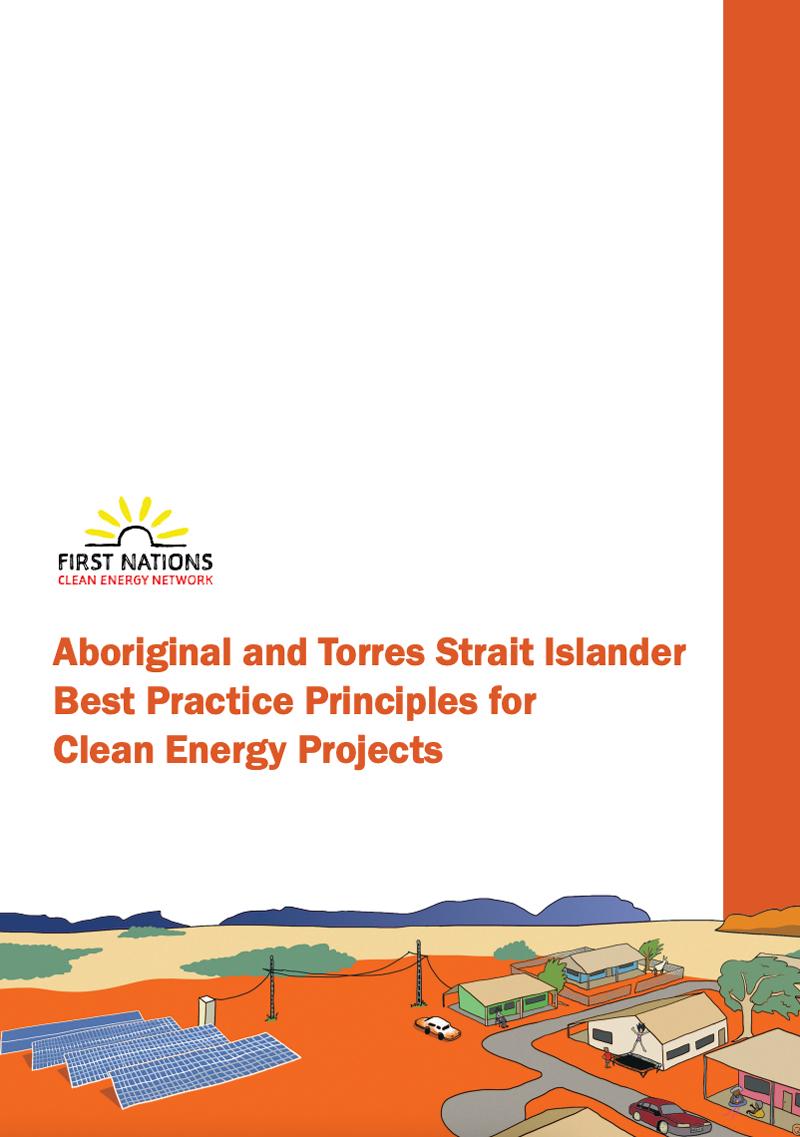
The Best Practice Principles for Clean Energy Projects, developed by the First Nations Clean Energy Network, offer a bold, actionable framework for governments, industry, and investors who want to lead—not lag—on equity, sustainability, and project certainty.

These ten principles are a strategic roadmap. They guide proponents to engage respectfully, secure Free, Prior and Informed Consent (FPIC), protect cultural heritage, embed land stewardship, and ensure economic and social benefits flow to First Nations communities. They reflect global human rights standards, including the UN Declaration on the Rights of Indigenous Peoples, and elevate what responsible development looks like in the clean energy era.

Proponents wanting to be recognised as industry leaders and setting the benchmark for responsible development must commit to undertaking their projects in line with the Best Practice Principles — from the earliest stages of planning through to decommissioning. 

Regardless of the minimum legal requirements, proponents must adopt these principles early to gain trust, de-risk approvals, attract premium investment, and unlock faster project timelines. And investors demanding them will help ensure long-term viability and social licence.

These principles are the foundation for doing business with First Nations on Country—and doing it well.

Find these guides and more in our Toolkit to assist your clean energy journey.


The principles
  1. Engage respectfully
  2. Prioritise clear, accessible and accurate information
  3. Ensure cultural heritage is preserved and protected
  4. Protect country and environment
  5. Be a good neighbour
  6. Ensure economic benefits are shared
  7. Provide social benefits for community
  8. Embed land stewardship
  9. Ensure cultural competency
  10. Implement, monitor and report back


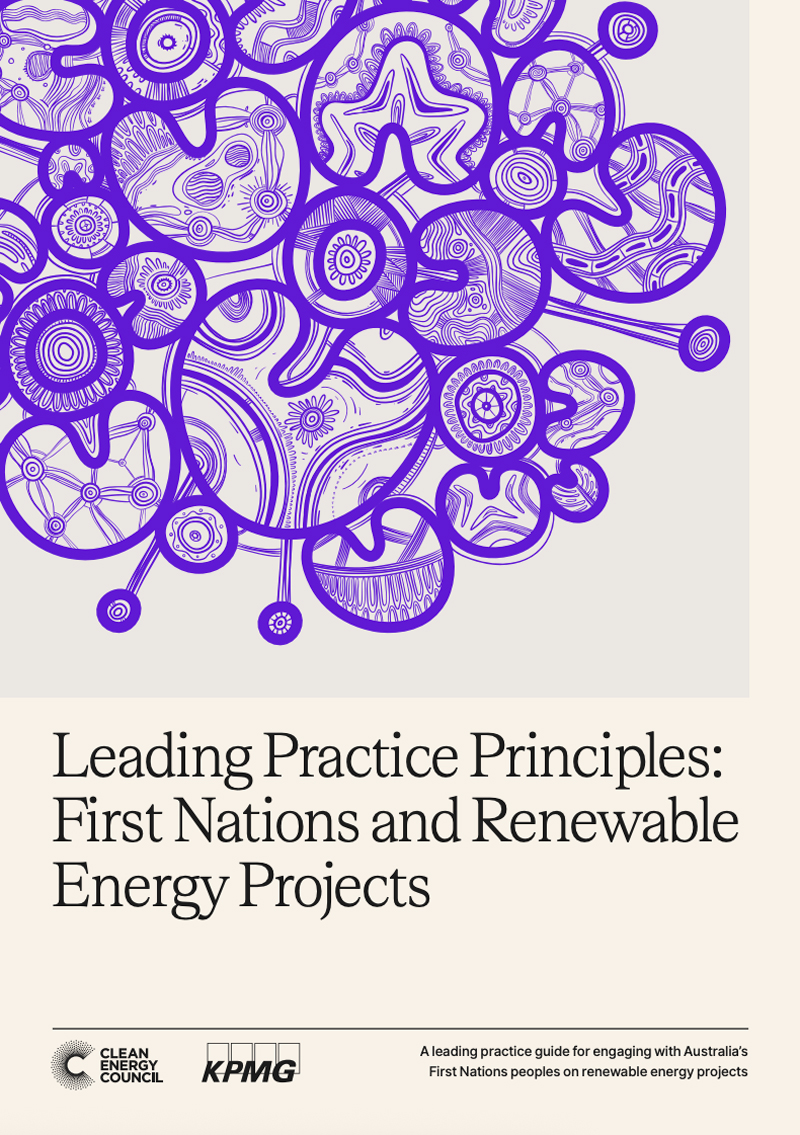
Leading Practice Principles: First Nations and Renewable Energy Projects

The Clean Energy Council and KPMG worked with the First Nations Clean Energy Network to operationalise the Network’s ‘Best Practice Principles’.

The subsequent Leading Practice Principles sets expectations for meaningful engagement and partnering with First Nations, detailing key considerations for engagement at each stage of a project’s life cycle including how to exercise meaningful engagement, consent, participation and benefit-sharing with First Nations people.


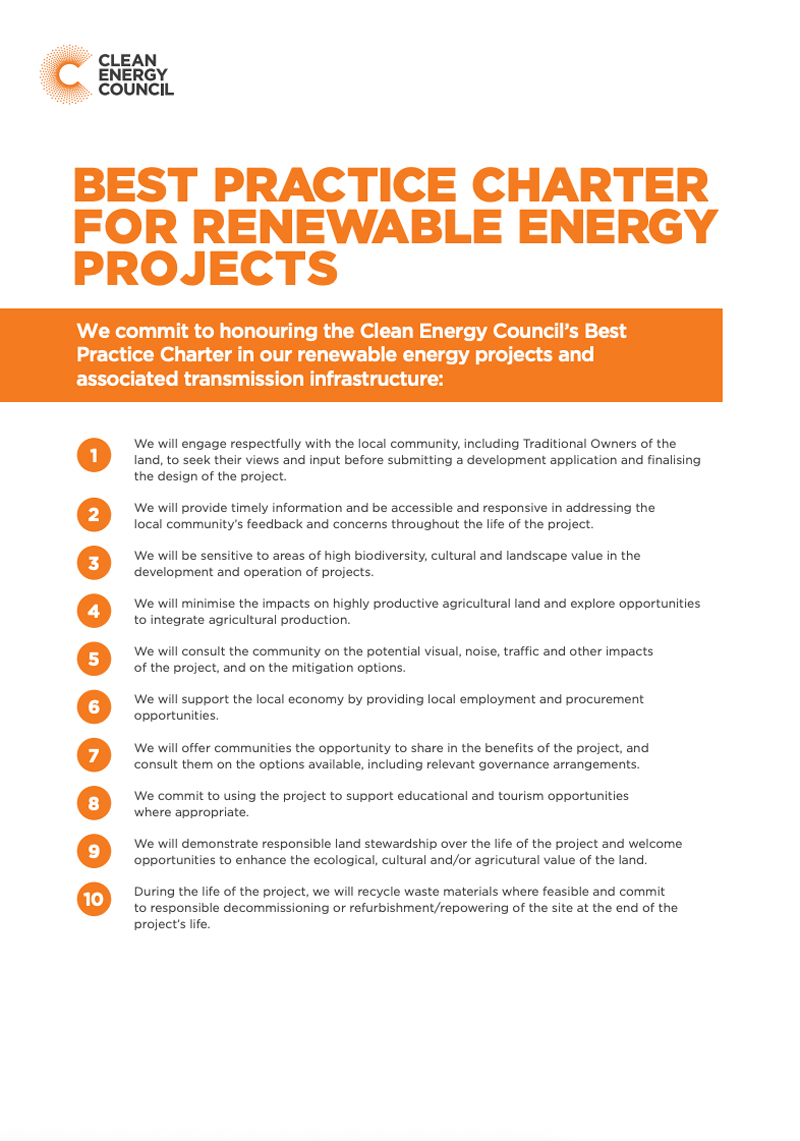
The Best Practice Charter for Renewable Energy Projects 

The First Nations Clean Energy Network’s Best Practice Principles have also have made their way into industry practice and reporting frameworks.

The Clean Energy Council’s Best Practice Charter for Renewable Energy Projects is a voluntary set of commitments for the clean energy industry. It outlines the standards that signatories need to uphold in the development of current and new clean energy projects. That includes engaging respectfully with the communities in which proponents plan and operate projects, including with the Traditional Owners, to seek their views and input before submitting a development application and finalising the design of the project.

It further includes offering communities the opportunity to share in the benefits of the project, consulting them on the options available including relevant governance arrangements, and providing local employment and procurement opportunities, to make a positive contribution to the regions in which they operate.

This Toolkit is subject to change and improvement as more information becomes available. To report content updates or broken links, please click here.